I watched the first episode of Loki… Again.

food snack popcorn movie theater

As the scenes that make up the Marvel Studios logo played out, I realized something. I recognized both the scenes from the MCU and the comics they were based on. Marvel Studios is so successful, in part, because they have such a deep well of ideas and storylines to draw from. The comics have been pumping out stories for over 50 years, thousands of fully developed characters and settings from Earth 616 and the Nine Realms to the Negative Zone, to Xandar, to times and places too numerous to list.

My realization was, I’m on track to do something like that too. I’ve built a version of Earth for Fantastic America and linked it to many other worlds to explore in the Magic Unleashed series. My work on “Lari and the Pox” has opened a few more new worlds. And I have a backlog of Renegade Galaxy worlds and notebooks full of settings for stories I haven’t put any real effort into fleshing out in years.

I’ve already built a multiverse for stories I haven’t even outlined yet. My imagination has far exceeded my narratives, but that isn’t exactly a problem. I just have to keep my butt in the chair long enough for the stories to catch up to the ideas. What a terrible problem to have!

I love world building…

I’m working on a short story, “Lari and the Pox” set in a new world. The story is simple enough, it only took half an hour or so to outline. I didn’t outline it until I had most of the world designed. The people are unique and their history has taken shape. I’ve worked out a geography, seasons (five), and unique words to describe the differences between Lari’s world and ours.

All of this I’ve done for a story of less than 5,000 words. I intend to write more stories here, so its not wasted effort. The threads came together so easily, and I lost myself in the act of weaving those threads together to make an entire world come alive. There is now a reason for everything in this short story to happen.

When I was a teenager, I liked to create characters for role playing games. Of course that didn’t satisfy me, so I also had to create worlds for those characters to inhabit. That led me to creating a whole game system and storyline. That storyline eventually evolved into the Renegade Galaxy series of short stories. Someday I’ll have to revisit that universe.

Working on this story and the world I wanted it to inhabit, brought back a flood of memories about how much I enjoy world building. I’ve become a student of the process, diving into geology, sociology, and more to make realistic worlds. I built several worlds for the Magic Unleashed series, but haven’t had the chance to bring them all to life yet.

This short story has reminded me of a joy I’d almost forgotten about. Finding the genuine joy in writing makes the whole process easier. I am happy to have rediscovered this aspect of writing so that I can keep that joy alive, and share it with my audience.

When I’ve worked on one project for too long…

white and black weekly planner on gray surface

Passion for a project can keep me going for a long time. At some point, I have to force myself to move on (even if only temporarily) to a different story. Staying with the same characters, the same plot, or the same settings can curtail my creativity. To keep things fresh, and keep my mind from contracting to one set of circumstances, I have to change up what I’m working on.

My debut novel, Fantastic America, has been my focus for most of the past three years. But even with it, I’ve changed my focus with short stories, and my foray into Midwestern Magicians for NanoWrimo. Now I’m taking a break again (briefly) to write a completely new story with an actual deadline and everything. I’m not a fan of working under pressure (I put enough of that on myself).

This doesn’t mean I will stop querying Fantastic America or thinking about how I might improve my pitch for it. But for a few weeks, I’ll be building a new world, and writing a new story. I started with a writing prompt (something else I don’t usually do) and had the bare bones of the story worked out in less than twenty minutes.

What started out as a lark of a thought experiment grew into a full fledged story that I was pulled into. When I grin at how well a few ideas come together, I have to follow the rabbit hole. I may not see how deep it goes this time, but I can visit again later and dig as deep as I want.

Like En Vogue said, “Free your mind, and the rest will follow.”

Inspiration comes at unexpected moments…

silhouette of man with light bulb at sundown

Aha moments almost have to come from places your attention doesn’t usually focus on. My brain at least, follows predictable tracks. If I want something to steer me in a new direction, it has to come from ‘out of the blue’. I’m a happy writer when something unexpected jolts me into new ideas, or a new way at looking at an old idea.

For example, I have a critique partner who is writing an amazing fantasy story. I held off sending my latest critique to her for a couple of days. There was something in the chapters I’d read that didn’t sit right with me, but I couldn’t put my finger on what it was. During a live call in another writers group yesterday, a guest developmental editor was talking about prologues, first chapters, and how authors can get too hung up on labels. Suddenly, the idea I couldn’t articulate snapped into focus for me.

I can’t count how many times something like that happens. I could be in a totally different state of mind, listening to, reading about, writing, or discussing an unrelated idea. But in a moment of blessing from my muse, BAM, a fully formed idea erupts from my subconscious. I have to hurry to write that gem of an idea down lest Lethe wash over me and I lose it.

That brings me to a great point I try to point out in this blog often. Explore varied interests, do different things, challenge yourself, expand your horizons, get out of your comfort zone. The results are worth the temporary discomfort. You just might find a few gems that change your writing or your life!

Magic means many things…

Even outside of fantasy stories, magic has many flavors. Magic was how our remote ancestors explained things they didn’t understand. As we learned more about how the world around us worked, magic fell in and out of favor.

In Europe, magic had a public relations problem until the mid 20th century. Africa has a long and varied history with magic and mysticism. Islam also distrusted magic, although belief in Djinn and forces beyond human control were widely accepted. Asia has as many different beliefs in magic as there are different people across the continent.

Australia, and the many islands of the Pacific also viewed magic as a real part of life. The Americas incorporated magical beliefs into everyday life, with different stories and traditions. The modern world views magic as an fossil from our collective history. As people learn more about science, technology, and engineering, magic fades away until there is nothing left.

My book, Fantastic America, explores how the 21st century might react to the sudden reappearance of magic. Would people embrace a power they don’t understand, would they study it to learn more, or might they reject it outright? Religion and magic have often been at odds, especially Islam, Judaism, and Christianity. How would a more secular society react to manifestations of powers and events with no obvious explanation? The Magic Unleashed series will try to answer these questions, and more.

What I’m feeding my inner author…

medicament and fresh fruits and veggies placed on table near unrecognizable person

Food has been on my mind a lot, lately. My relationship with food has never been a priority. Don’t get me wrong, I love to eat. I’ve tasted phenomenal dishes from all over the world. I just never saw food as much more than fuel for the tank. Sometimes it was better than others, but it all ended up in the same place.

My body got tired of that approach, and let me know that in the most unsettling ways as I’ve aged. So, I’ve revaluated how and what I eat. I’m taking portion size into consideration, reading the labels on the food I buy, and watching the carbs in the food I choose like my life depends on it. Which it turns out, is true.

That got me to thinking about other things I consume. As an author, I considered the inspirations I take in. Are they all from the same source? Do I have a bias for one thing over another, or am I reading too much into my comfort zone. There is a lot to examine.

It turns out, I have a pretty eclectic mental diet. I read in and out of my genre (the out parts come from critique groups). My visual stimuli come from movies, TV (not a whole lot of either lately), and the vast (and varied) pins I peruse on Pinterest. The music I listen to is varied too, but most of that comes from sharing space with my loving wife (we often disagree about what to listen to).

In all, I’m feeding my creative side a diverse diet that expands with time. I’m no renaissance man, but I feel comfortable that I’m not stuck in a rut either. Time will tell, but if a stray Beastie Boys lyric makes its way onto my page, at least I’ll know why. Staying mindful…

One morning an ancient Egyptian woke up…

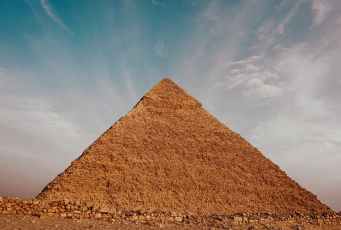
And said, “You know what we need over there? A big old pile of rocks. But not just any old pile, this one should be a pyramid. Bigger than any of those little bent pyramids like my grandpa had built.” Today, we still marvel at the Giza complex. None of that would’ve happened (Aliens notwithstanding) if not for a singular idea and the drive to see it to completion.

The same is true for us, maybe not pyramid building (but hey, if that’s your thing, go for it). I have a vision. Each day, I summon the will to make it a reality. For authors like me, that means sculpting that vision into words on the page. The vision may manifest in waves, first draft, revisions, and a final product. Eventually, the pyramid will reveal itself for all to see.

There are plenty of obstacles between the vision and the pyramid. Life comes up with lots of reasons not to add stones to the pile. The pile itself may need adjusting. The wind may be wrong for my writing mood on any given day. I have to push past all of that, make another deposit on the page, or revise what I’ve piled on before, until the monument can endure without me for millennia.

I don’t actually expect to build a pyramid on the page in my lifetime. My work may not even outlast my lifetime at all. But I intend to add to the pile, adjust as I see fit, until the best monument I can manage emerges. Even if nothing lasting comes from it, the effort will have been worthwhile to me.

Life piles up on all of us…

person using macbook pro on table

Family commitments, housework, actual work, and every other little issue that can come up to keep me from writing does. Like an Author’s Corollary to Murphy’s Law, “Whatever can interfere with writing, will.” Sometimes, being creative and putting my butt in the chair to write feels like the worst use of my time, although I don’t believe that at all.

That was certainly the case with Pitmad today. I planned ahead for it, even made changes on the fly to keep up with it. Traveling at the time the pitch fest started proved to be only a small hiccup. The real show stopper was when I ran out of energy. I missed the last five hours on twitter, because I just couldn’t keep my eyes open anymore.

Still, the day went well, all the appointments were kept. I got some time in to write, and yes, this counts, too! Two out of three pitches went out to Pitmad, along with lots of retweets. I can’t say enough about how the writing community on twitter comes together to lift each other up for pitchfests. Today was no exception.

So yes, life piles up on us all, but it doesn’t have to keep us from what we love. It doesn’t have to interfere with writing, but if it does, breathe. For most of us, there is always tomorrow, thankfully.

There is only one way to learn to write a novel…

macbook pro on brown wooden table

MFA programs can teach you all about writing, the three act structure, character development, setting and so on. What they can’t teach you is how YOU put all the pieces of your novel together. They can’t find your voice for you or discover the themes that are most important to you. That only comes from writing and rewriting your narrative.

That usually means an author’s first book doesn’t work well. For example, it has taken a lot of effort to shape my debut novel, Fantastic America into a sellable book. I’m still tweaking chapters and examining what I can change with critique partners. But none of that is a bad thing. Several authors I’ve talked to threw their fist novel in a drawer hoping for a better second book.

More important to me, from my experience writing a novel. I’ve learned how I write. Last year I learned I can churn out a 100K word novel in two months. I wrote the first 50K words of Midwestern Magicians during Nanowrimo in November. The best lesson of all is that I know I CAN finish a novel length book, easily worth the struggle. No MFA program required.

Not that those programs aren’t a great help, it just isn’t the path I followed. A good program would likely have made my life easier. You have to put your behind in the past, or whatever they said in the Lion King. I’m not the least bit unhappy with where I am now or where my work is headed. The sooner I can share my books with readers, the better.

Speaking of that, Pitmad is today! I’ll be pitching Fantastic America and watching Twitter for likes from agents. Wish me luck or a broken bone, whatever your superstition demands for good fortune. I’ll need it.

Pitmad is tomorrow…

red blue and yellow textile

It hardly seems like the last one was a few months ago. If you aren’t familiar, it’s a pitchfest on twitter for authors to find agents who love their books. I’ll be pitching. If you follow me on Twitter, RT my pitches but save the likes for agents. I got super excited last time for the likes that weren’t agents at all, just interested followers. SIGH – it’s love, but not the hearts I’ll be looking for!

The dead don’t play by the rules…

In Fantastic America, ghosts are an aberration. They exist, but they shouldn’t. Likewise, creatures of necromancy routinely ignore covenants that should keep them from entering the world of the living entirely. That puts a strain on reality no one entirely understands.

There is a lot of poorly understood or plainly unknown activity going on in my debut novel. A portion of the plot is an attempt by all the POV characters in the book to understand what is happening and why. Its obvious monsters, magic, and miracles are popping up around the world, but why? And why now? The answers will come from diligent research, along with a hefty dose of trial and error.

Zombies are a danger that left unchecked would threaten the entire planet. Wraiths, as dangerous as they can be are a limited threat. Ghosts although definitely dead, don’t follow the pattern of the others. In fact, they were here throughout the bleak times of no magic. What sense does any of that make?

The greatest threat from the characters limited understanding, would be someone who could control the dead. Someone who could direct zombies, control wraiths, and expand the list of monsters already dead but still extremely active. That’s the very definition of necromancy.

What is magic?

young female astrologist predicting future with shining ball

In real life, Western culture lumps a lot of things together as ‘magic’. Enchantments, spoken incantations, various kinds of spells, curses, hexes, witchcraft, divination of the future, necromancy, consulting ancestral spirits, and astrology all fall under some definitions of magic. Those are useful ideas for the real world, but what is magic in fiction, especially fantasy?

In my debut novel Fantastic America, and the rest of the Magic Unleashed series, magic is a force of nature. It ebbs and flows in the physical universe, but that makes it even more difficult to work out a science based definition. Ultimately, magic is a force that responds to thought and will to cause changes to the world that would otherwise be impossible. That’s a good working definition for the stories I write in the worlds of Fantastic America. Other stories may follow different rules.

Of course, in my stories there is a lot more to magic than that simple definition. There are many ‘flavors’ of magic, different schools or kinds of magical traditions. Within the novels and short stories of the Magic Unleashed series, I explore each of those traditions. Some, like necromancy are unpleasant for anyone outside that tradition.

Faith based miracles, that can save people with little or no magic at all, are a function of belief. The largely instinctive magic of arcanists, fueled by ambient magical energies all around them, operate on a intuitive or subconscious level. The wildly powerful spells and rituals of wizards can warp the very fabric of reality. That is the purest expression of magic in the modern world.

Sometimes I have too much to write about…

wood writing typography letter

For me, sorting the ideas I want to share is often more difficult than not having an idea to write about at all. There is always some idea or another floating around in my head. Deciding which ideas fit together takes up more of my time than writing.

Some of the best ideas I have come as I’m drifting off to sleep. A lot of creatives I’ve talked to have the same experience. The bridge to our subconscious connects at just the right time, and BAM there is a flood of ideas to keep me awake! I have to write them down as fast as I can or they fade away.

The problem, if you can call it that, is that I have so many ideas that kind of fit together, grouping together like ideas isn’t enough. I also have to build some kind of framework that helps these ideas form a bigger concept or at least a coherent narrative. That effort keeps me up late too.

I’m certainly not complaining about having a wild imagination. Plenty of writers struggle to come up with an idea they feel is original enough to write about. My problem is narrowing the field to just the ideas that can carry a story. Working those concepts into characters, setting, dialogue, and description feels easier by comparison.

What a difference a day makes!

male doctor in uniform putting on sterile gloves

Humans take some things for granted. We rely on what we’ve experienced to guide us. When something we rely on fails to match our experiences the change is jarring, to say the least. I spent the past month dealing with a series of jarring episodes.

Most recently, I had a kidney stone removed and a stent put in. I won’t bore you with the messy details, but I haven’t felt ‘good’ in over a week. Yesterday I had the stent removed. Today I feel so much better, it’s hard to believe I felt ‘bad’ at all!

So I’m up early (I slept a lot the past week). I’m working through the list of things I’ve put off doing the past week. I don’t expect this burst of activity to last, but I’ll take advantage of the energy while I can. My posts the past few days are a reflection of how drained I felt.

All that adds up to this, your state of health, mood, energy, and attitude all affect what and how you write. Just as it’s hard to write happy thoughts when you’re sad, writing anything is difficult when you’re not well. I can’t always control illness, but I can control what I eat, exercise, and how much rest I get (ok this last one is always big challenge for me). So that when I sit down to write the words flow naturally.

Magic doesn’t always align with Morals…

woman in black and brown long sleeve shirt with white face mask

Magic is a force of nature. Supernatural perhaps, but still not beholden to concepts like good and evil or right and wrong. Like any tool, magic in the wrong hands can be deadly. Anyone can use magic for ill or good, with one exception. Necromancy is a corruption of life, death, and magic itself. As such, other magic users universally hunt down and destroy necromancers.

Among arcanists who weather the bleak times of no magic, most avoid the temptation to employ dark rituals. Those who do are human in name only. Power in the bleak times comes from the only consistent source of magic, human sacrifice. Foul atrocities like murder and torture gave a handful of arcanists ill-gotten power over the past six thousand years.

Modern magic users in the world of Fantastic America have little or no idea how magic works. Yet even modern arcanists who drew power from murder lost all understanding from the last magical age. Only a few desperate and deranged would-be magicians sought out the lone source of magical knowledge still accessible.

As necromancy is a great corruptor, the secretive Mistress of Shadows is the greatest corruptor of all. She alone has dared to break the ancient covenants that bar other immortals from interfering in mortal affairs. The few who have won her favor have perpetrated the worst kinds of torture, bloody rituals, and depravity. Their mistress’s rewards made them powerful, defied aging, and staved off death itself, for a time.

Magic users of the modern world have no idea of the forces unleashed by the return of magic. Monsters not seen in thousands of years roam the Earth. Unsettling eruptions of magic change familiar locations into places of power. Meanwhile, intelligences older than our oldest ancestors wait for their moment to break the last bonds that restrain them.

I’d like you to meet Corporal William Hyatt…

Bill was a Union Army sharpshooter who died at the Battle of Gettysburg. You will meet Cpl. Hyatt’s ghost in Fantastic America. His death, while tragic, is only one aspect of how he impacts the story. Bill has inhabited a specific part of the Gettysburg battlefield, called the Devil’s Den, for almost one hundred and fifty years.

Even after most spirits in the world disappeared on the night of the Winter Solstice in 2012, Bill remained behind. You will learn more about his life, death, and afterlife in my debut novel. His part in the story may seem inconsequential at first. Rest assured, he plays an important role as the keeper of a secret. Even he doesn’t realize how vital this information will become.

You don’t have to be a Civil War buff to appreciate his contribution to the novel. He’s more than capable of relaying his truth. I trust my readers to be able to figure out as much by what he doesn’t say as what he does say. Bill’s part of the story is a tragedy on may levels, and the company he falls in with is entirely to blame.

Coping with insomnia as a writer…

light people night smartphone

It feels like I’ve had trouble sleeping my whole life. Even as a child I struggled to get a good night’s sleep. I worked odd hours in the navy, and preferred the night shift when I had a choice. As a civilian I also worked nights and partied into the wee hours.

Since I’ve been writing as more than a hobby I’ve used my lack of sleep to help me get words on the page. The house is quiet at night, and the most that might disturb me is walking the dogs once an hour or so. I’ve adapted to all of that, and generally don’t even think much about it.

That is, until my poor sleep schedule intersects with the ‘normal’ routine of day walkers. My plight tonight hinges on that intersection. I have appointments I can’t miss during the day and over an hour of travel time each way. My loving wife has taken time off for the worst of these, but tomorrow comes in about five hours.

I’m hardly complaining, I’ve waited for one of these appointments for over a year. The timing isn’t bad, it’s my uncooperative sleep schedule that does this to me most of the time. I loaded up on melatonin, but doubt it will help me drift off. I wrote all of this to say, don’t be surprised if I am slow to post again tomorrow!

The online writing community rocks!

facebook application icon

Not only do they rock, they are spread out enough that any bumbling idiot, like me, can find them. More than once when I was discouraged about where my writing was, I considered giving up. Each time I pushed a little longer and searched a little harder.

First I found KBoards, that was my first glimpse of my writing tribe. I was writing short stories to self-publish on Kindle Unlimited. I read an article by Hugh Howie about how he’d struggled with exactly what I was going through. He pushed on, and I did too. KBoards had so much information that I couldn’t process it all at once. I still go back there once in a while.

That experience led me to FB writers groups, where I made my way into an online critique group. My writing craft went from terrible to passable in less than a year. I also almost quit over the critiques I got, but my critique partners didn’t give up on me, and I didn’t give up on my dream.

I took courses online, and in the middle of the pandemic, I took a writing course with Ashley Mansour, a personal coach and best selling author. My craft improved again, but I also learned more about structure, time management, and literary devices that I thought I already knew. It took me just over 30 days to finish Fantastic America with that course. I highly recommend Ashley’s course if you’re struggling to complete your first book, fiction or non-fiction.

I found more groups online that were there to help me edit my manuscript, query agents, and land the traditional book deal I’ve been chasing. Every time I need to learn about something writing related, I’ve found a group online (FB, Twitter, or on a site by themselves). The #writingcommunity group on Twitter is especially friendly and helpful. Pitmad and Pitdark prove that to me over and over again.

I haven’t thought about giving up in over a year. A lot of that is due to the social aspect of writing. I’ve found so many online groups whose members have overcome the same solitary struggles I dealt with, and helped me avoid lots of self-sabotage. If you’re struggling, find your tribe. They are out there and willing to help you help yourself.

I use Pinterest every day…

If you’ve followed my blog for any length of time you might already know how much I adore Pinterest. I have over 4000 curated images for different story ideas. Most are fantasy concepts, but there are also sci-fi and historical pins in the mix.

I spend hours at a time scrolling through pins for inspiration. The rabbit holes I’ve searched are many and deep. Still, I don’t feel as though its a waste of time (it can be but not always). Some of the pins I’ve come across have opened up whole new vistas for my imagination.

The pins I’m most inspired by are seldom considered grand art. What I look for runs from gritty realism to outright absurdity. All of them capture an essence of what I have in my minds eye. Sadly I have no artistic talent for drawing or sculpting. I only know what I like when I see it.

Pinterest fills that visual gap for me daily. I know I’ll find a map of the African Humid Period, or the Pontic Steppe at the end of the last ice age. (Yes I’ve looked both of those up!) Or I can find examples of people I can imagine lived in those places in those times. All useful imagery to spark my imagination.

Tinkering can be dangerous…

rewrite edit text on a typewriter

Having a ‘finished’ manuscript is all well and good. Having time to tinker with that story can lead to revisions you didn’t plan. That isn’t always a bad thing, but it can lead you down a rabbit hole. I knew this already, and waded in anyway.

I’ve had a lot of time on my hands recently, and once I felt up to sitting at my desk again, I decided to try some ideas for Fantastic America. These were more than a few edits. There were supporting characters I was unhappy with, scenes I knew could be better, and a sense that some aspects of the story needed more kick.

So here I am, with a few chapters in momentary disarray. I’m hunting for name mentions as I gender swapped a couple of characters. I found a way to pump up the volume here and there. And tied it all together with a character reappearing near the end of the story.

I like where I’m at, but I wouldn’t recommend it to anyone. Some of these changes should have occurred to me sooner. None of them are absolutely imperative, but they make me feel better about the story. Also, I needed to do something besides pitch on Twitter! (Which I also really enjoy.)